
Italian parlamientarians, healthcare executives, and academics convened in New York to align both nations on ethical innovation and patient-first care models
A landmark international conference brought together institutional leaders, healthcare professionals, and academics from Italy and the United States at the Consulate General of Italy in New York on Monday to advance a shared vision for more ethical and human-centered healthcare systems.
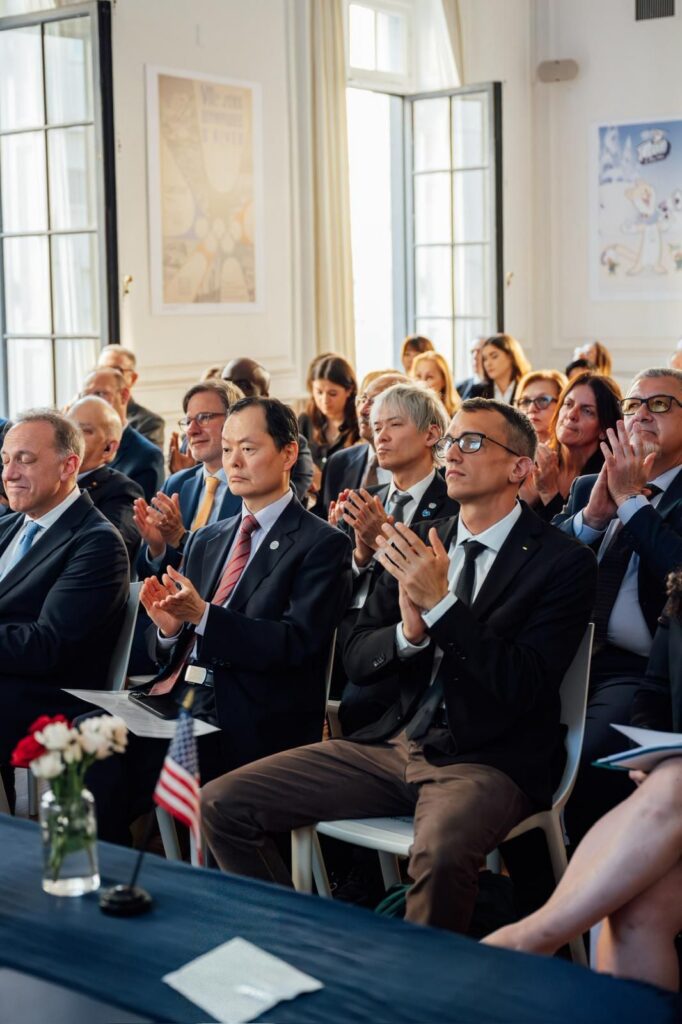
The event, titled “Ethics, Innovation, Care: The Italy-USA Dialogue for a More Human-Centered Healthcare System,” was promoted by two Italian Parliamentary Intergroups: “Progetto Italia,” chaired by Hon. Erica Mazzetti, and “Healthcare and Recovery,” chaired by Hon. Simona Loizzo. The symposium, coordinated in New York by US Lead Diplomatic Advisor Jennifer Adriana LaDelfa, formed part of a broader institutional mission aimed at deepening bilateral cooperation on healthcare, technological innovation, and patient-centered organizational models.
Consul General of Italy in New York Giuseppe Pastorelli opened the proceedings, setting a tone of diplomatic purpose and shared responsibility. Italian Minister of Health Hon. Orazio Schillaci delivered institutional greetings via video message, while Don Marco Belladelli, Coordinator of the Pontifical Commission for the healthcare activities of public juridical persons of the Church, addressed attendees remotely. The conference was moderated throughout by Eng. Alessandro Astorino, Secretary General promoting the Parliamentary Intergroups.
Hon. Mazzetti and Prof. Vittorio De Pedys, President of SIMEST S.p.A., opened the substantive sessions by underscoring the strategic importance of internationalization and investment in the healthcare sector. Their remarks set the stage for an ambitious program of panels featuring prominent voices including Tino Ruta, CEO of Knights Care LLC; Massimo Mangini, President of the Mangini Group; Marc Zimmet, CEO of Zimmet Healthcare; and Alessandro Salatino of the Dana-Farber Cancer Institute at Harvard Medical School.
Tanya Enigk, Vice President of CCORisk Management, offered a rigorous framework for sustainable healthcare delivery, centered on three interdependent pillars: quality of care, patient experience, and care coordination. She argued that all three must function together for a healthcare system to hold. Drawing on her experience spanning frontline clinical social work and corporate compliance, Enigk emphasized the dangers of losing sight of the individual patient amid institutional pressures. “Sometimes we lose focus, and we really just don’t talk to our patients,” she said, “sit with the patients and talk to them, to understand how are they feeling about going home.” She also made a pointed case for reorienting financial incentives away from volume: the goal, she stressed, is measuring not how many patients are treated in a day, but how well each one is cared for and transitioned home safely.
Ken Kitatani, ICEED Governance Officer, presented an AI-powered remote monitoring device currently in development that holds significant promise for underserved and elderly populations. The technology is designed to analyze complex biological patterns and, in its next phase, may be capable of detecting early markers of cancer in white blood cells without requiring patients to travel to specialists. “This is not science fiction,” Kitatani said. “It is the beginning of a new model of healthcare.” He grounded the innovation in a five-part ethical framework — human dignity, privacy and consent, equitable inclusion, transparency and accountability, and solidarity — cautioning that technology without ethics can deepen inequality rather than reduce it. He called on Italy, Europe, and the United States to collaborate on an international model in which advanced technology is guided by human-centered values.
Discussions ranged across eldercare challenges in both countries, digital health innovation, sustainable healthcare management, and the emerging frontiers of precision medicine. A unifying thread throughout the day was the “humanization of care” that placed the individual, not the institution, at the center of every healthcare pathway.
Monsignor Hilary Franco, Advisor to the Permanent Mission of the Holy See to the United Nations, delivered the closing remarks, drawing on the Church’s centuries-long tradition of healthcare ministry — from the founding of the first hospitals to its contemporary role in advocating for the vulnerable. He framed the day’s dialogue as a moral calling. “Technological progress and the management of healthcare always should remain in the service of human dignity,” he said, “especially of those who are most in need.” Invoking St. Augustine’s maxim that actions speak louder than words, Monsignor Franco urged attendees to carry the spirit of the encounter into concrete cooperation, and closed with a blessing for the work ahead.
The conference marked a meaningful step toward cooperative frameworks that balance innovation, economic sustainability, and respect for persons, setting the course for a model both nations expressed commitment to developing further.
Originally posted at: La Voce di New York: https://lavocedinewyork.com/en/new-york/2026/04/14/italy-and-u-s-chart-a-human-centered-path-forward-at-ny-healthcare-summit/