
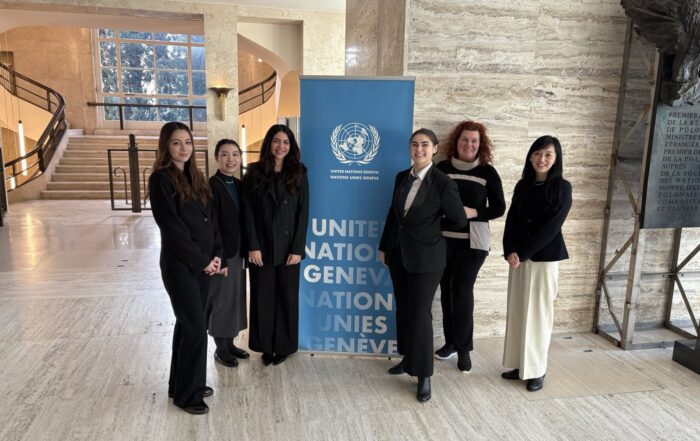
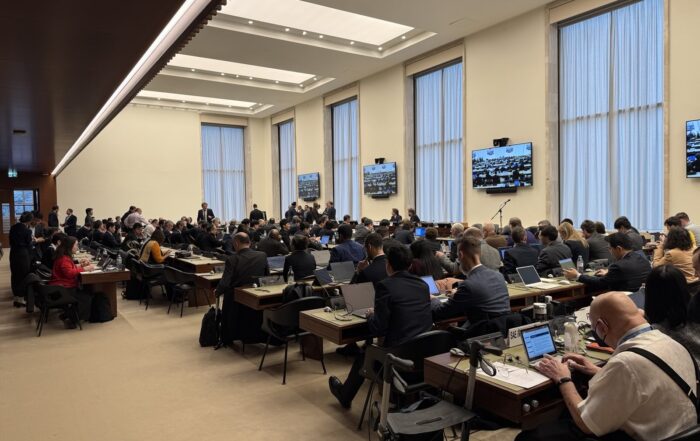
I-CEED attended the 24th session of GRVA, held at Geneva’s Palais des Nations on January 19-23, 2026. GRVA (Working Party on Automated/Autonomous and Connected Vehicles) is a subsidiary body of the WP.29 (World Forum for Harmonization of Vehicle Regulations), which is a global platform focused on developing internationally harmonized vehicle regulations, affiliated with the United Nations Economic Commission for Europe (UNECE). GRVA serves as the technical body preparing draft regulations and guidance for WP.29 to adopt in the domain of automated, autonomous, and connected vehicles.
The work of GRVA and WP.29 takes place within the framework created by UNECE’s 1958 and 1998 agreements. The 1958 agreement establishes binding U.N. regulations (UNRs) on the technical specifications for vehicles. All signatories must enforce the UNRs uniformly, promoting regulatory consistency and facilitating trade. The 1998 agreement creates a complementary, but non-binding, framework of global technical regulations (UN GTRs). Unlike the UNRs, GTRs are not direct legal obligations, but performance-based standards designed to be transposed into national legislation. Together, the two agreements create a structured, yet flexible, system that supports international alignment while accommodating different approaches to regulation.
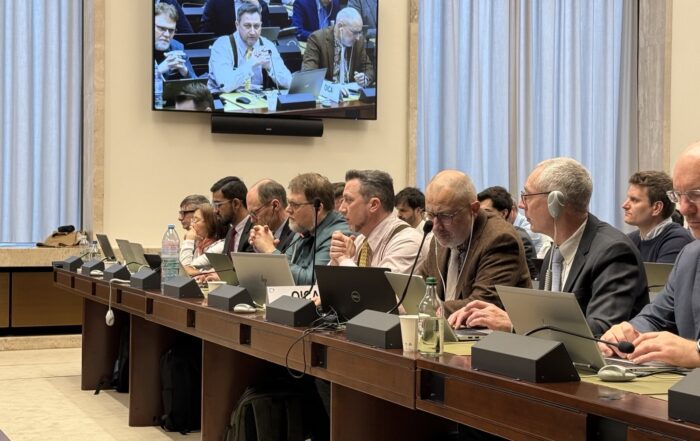
GRVA participants included countries that have joined both agreements, including the European Union, Japan and South Korea, as well as countries that only participate in the less binding 1998 agreement, including the U.S., China and Canada. To accommodate them, the GRVA has parallel work streams focusing on the development of UNRs and GTRs. Much of this preparation is carried out through GRVA’s informal working groups (IWGs), which bring together experts to draft proposals on specific topics, including automated driving systems (ADS), cybersecurity, and AI.
A central focus of GRVA 24 was maintaining momentum on ADS regulations, which are expected to be finalized at the WP.29 meeting in June 2026. Delegates made significant progress, recommending a draft GTR on ADS and advancing a parallel UNR under the 1958 agreement. This coordinated approach supports regulatory alignment across different legal systems and provides clarity for manufacturers preparing to deploy ADS-equipped vehicles internationally.
The session also highlighted continued progress within the AI working group, which was established in 2025 to address the growing role of artificial intelligence in vehicles. The group has been refining terminology, examining safety-relevant AI use cases, and developing guidance to support responsible risk management. Its work demonstrates a proactive effort to ensure AI integration in vehicles is accompanied by robust governance principles.
With several current IWG mandates set to conclude in June, GRVA members also began considering the future structure of its working groups to ensure continued responsiveness to technological developments. Discussions reflected a shared recognition that regulatory cooperation must evolve alongside rapid innovation in automation and AI. Updating mandates and refining the scope of existing or new working groups will help maintain clarity of purpose, avoid duplication of work, and ensure that emerging safety priorities are addressed efficiently within the WP.29 framework.
ICEED remains committed to actively participating in GRVA and its AI working group, as this next phase of regulatory development takes shape. While the working group structure evolves, we will continue to support coherent, forward-looking approaches to the governance of automated and AI-enabled vehicles. We look forward to contributing our expertise to ensure that emerging regulatory frameworks remain practical, harmonized, and responsive to both technological progress and societal expectations.