
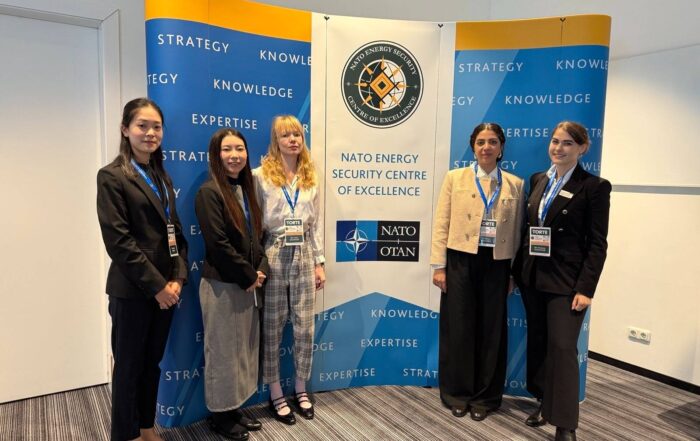
On September 16-18, 2025, ICEED attended the second annual FORTE (Future Operations – Resilience in Transitioning Energy) conference, organised by the NATO Energy Security Centre of Excellence in Vilnius. FORTE aims to facilitate multi-stakeholder discussion of energy security, bringing together experts from the public, private and defence sectors. This year’s conference highlighted the growing need for cooperation between these stakeholders, with the theme “Power in Partnership: Civil-Military Synergy for Energy Security”.
The agenda of FORTE 2025 comprised eight keynote speeches and six panels, with topics including “Allied Energy Interoperability: Building the Coalition Fuel Network of the Future” and “Critical Infrastructure Protection & Resilience”. While the first half of the conference was nominally focused on military energy security, and the second half on the resilience of civilian infrastructure, the intertwinement of the two was underlined by experts throughout the programme.
Primarily civilian-use energy infrastructure has become a military target and a key source of vulnerability, as seen in Ukraine. Hybrid threats on energy security have also taken new forms, including attacks on underwater cables in the Baltic Sea. Speakers emphasised that private-sector energy providers have a critical role in infrastructure protection, but they cannot respond to these threats alone. To improve resilience, coordination must be strengthened between industry, government, and defence forces.
Another focal point of the conference was the challenge of balancing civilian and military energy needs. While energy industries in Europe have already begun transitioning towards renewables, the defence sector is expected to remain reliant on fossil fuels for decades longer. Weapons and defence systems are also becoming heavier and more energy-intensive. This creates a risk that private-sector production of fossil fuels will fall below the level required by militaries, unless it is maintained through reciprocal partnerships and subsidies.

Ongoing decarbonisation efforts within the defence sector were also discussed at the conference. NATO has set a target to reduce its energy consumption on the organisational level, while most member countries have established their own decarbonisation strategies. To align with these commitments, defence forces are working on clean energy solutions for military applications. However, these initiatives remain small-scale, and the overall sectoral trend appears to be towards increasing energy intensity. This suggests there is a growing tension between commitments to mitigate climate change and improve military capabilities.
While the discussions at FORTE 2025 homed in on questions that have no easy answers in the present, they also contributed to identifying common priorities among stakeholders with different experiences and viewpoints. This is an important step towards harmonising approaches for enhancing collective energy security.